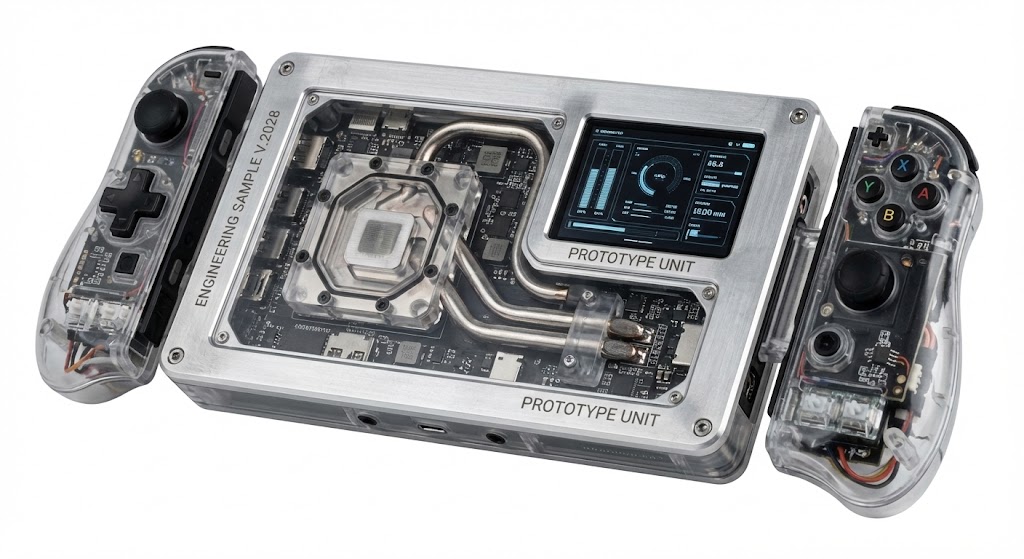
The handheld gaming market is undergoing a transformation. What was once a niche corner of the video game industry has evolved into one of the fastest growing sectors, driven partly by a fundamental shift in how manufacturers and developers think about accessibility. As of December 2025, the landscape of portable gaming devices designed for and adapted by players with disabilities has expanded dramatically, offering pathways into interactive entertainment that barely existed five years ago.
The market numbers tell part of the story. Global handheld gaming consoles are projected to grow from about 4.1 billion dollars in 2025 to over 11 billion by 2035. The personal computer handheld segment alone saw 2.3 million units sold globally in 2025, a thirty-two percent jump from the previous year. But behind these figures lies something more significant: the accessibility infrastructure supporting disabled gamers has finally scaled beyond experimental prototypes into mainstream consumer products.
Nintendo’s Switch 2, launched in June 2025, represents the company’s most ambitious accessibility effort to date. The original Switch was widely regarded by disability advocates as the least accessible console among the three major platforms. The sequel directly addresses this. The new iteration includes a built-in screen reader for navigating menus, text-to-speech functionality with customizable voice options and reading speeds, and support for high contrast modes and adjustable text sizes. Perhaps most crucially for disabled handheld players, the top-mounted USB-C port opens practical possibilities. The Hori Flex accessibility controller, which allows users to plug in alternative input devices, can now theoretically work with the Switch 2 in tabletop mode without the awkward cable positioning that plagued the original console.
Smaller design changes matter too. The buttons and joysticks are slightly larger, the console is more robust, and preliminary reports suggest that the infamous joystick drift problem may finally be resolved. The weight increase is a legitimate concern for players with chronic pain or reduced hand strength, but the overall ergonomic improvements signal that disability considerations were built into the design process rather than added afterward.
PlayStation has been moving steadily in this direction. The PlayStation Portal, a cloud streaming handheld released in 2023, received a revolutionary update in November 2025 that transformed it from a PS5 accessory into a genuine standalone device. The new update added cloud streaming for personal game libraries, meaning players no longer needed a home console to access their digital games. More importantly for accessibility, the device added new accessibility options including adjustable text sizes and screen reader support for cloud streaming games. The Portal is also remarkably comfortable to hold. With its paper-thin design and form factor that closely mirrors half of a DualSense controller, it requires minimal grip strength compared to other handhelds.
The accessibility innovations happening on other platforms might be even more significant. ASUS released the ROG Ally line of Windows-based handhelds, and Microsoft’s newer Xbox-branded handhelds began shipping in late 2025. These devices inherit Windows 11 accessibility features including narrator screen reading and on-screen keyboards, while also supporting full Xbox adaptive controller functionality. The input customization options available through Armoury Crate SE are extensive, allowing button remapping and sensitivity adjustments that can be tailored to individual needs.
Valve’s Steam Deck continues to dominate the handheld PC gaming space, and recent updates to SteamOS have added substantial accessibility tools. High contrast mode, screen reader integration, and motion reduction settings are now available in Big Picture Mode. The device’s support for external accessories is comprehensive, allowing players to connect whatever adaptive equipment they already use for PC gaming.
But the hardware is only half the equation. The third-party accessory ecosystem has exploded with products specifically designed for disabled players. The ByoWave Proteus Controller, which reached broader availability through partnerships with major platforms in 2025, uses a modular snap-together design with over one hundred million configuration combinations. Players can physically build a controller that matches their body and needs rather than forcing their body to adapt to a fixed form factor. The November 2025 announcement of the Proteus Builder, a more affordable variant designed for players who need fewer modules, signals that the expensive accessibility peripherals market is finally experiencing price competition and diversification.
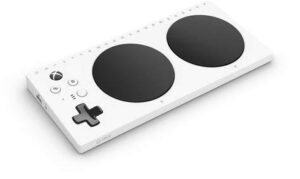
The Xbox Adaptive Joystick launched in early 2025 for roughly thirty dollars USD. This single device did something remarkable: it made affordable accessibility hardware a realistic option for disabled gamers. The joystick features customizable buttons, works with mounting equipment, and costs less than a standard new game. Combined with the Xbox Adaptive Controller, which has been available since 2018, players finally have a layered approach to accessibility. Someone can start with the affordable joystick, add additional switches and buttons over time, and build their setup incrementally rather than committing to a several hundred dollar investment upfront.
The 8BitDo Lite SE controller, developed in partnership with disabled gamers including a father seeking better options for his son with limited mobility, brought attention to an often overlooked hardware feature. The controller uses low-resistance buttons requiring minimal pressure to activate, and highly sensitive Hall Effect joysticks that respond to subtle movements. The Hori Flex accessibility controller for Nintendo Switch remains the only officially licensed adaptive controller for that platform, and it continues to represent Nintendo’s awkward relationship with accessibility. It is a capable device with twenty-plus 3.5mm input ports for connecting alternative switches and joysticks, but it requires docking and does not work in handheld mode.
Beyond traditional controllers, more unusual input methods have matured significantly. The Quadstick is a mouth-operated controller designed for players with severe mobility limitations. The device features a joystick topped with a mouthpiece containing multiple sip and puff tubes that can be programmed to perform different functions. Players with quadriplegia have documented that with proper configuration, the Quadstick enables participation in a wide range of games. The device connects via USB and allows completely customizable programming through Google Sheets, making it adaptable to individual needs and game requirements.
Eye tracking technology continues improving. Players with significant physical disabilities have integrated Tobii eye trackers with adaptive software to control games using eye movements alone. While eye tracking offers incredible promise for severely disabled players, practitioners note that for most gaming purposes, traditional adaptive controllers deliver better precision and speed. Eye tracking tends to work best in combination with other input methods or for turn-based games where the slower input speed is less problematic.
Software-based solutions have become increasingly sophisticated. PlayAbility Adaptive Software, launched in 2023 and continuously updated through 2025, allows players to add missing controls using webcam-based face tracking, voice recognition in twenty-four languages, and combinations with any existing controller or mouse and keyboard setup. Players can map over fifty distinct facial gestures to button presses or analog stick movements. They can speak commands to trigger actions. They can combine head movements with existing peripherals to create hybrid control schemes. The software works across Windows PCs and can extend control to Xbox consoles via remote play and Nintendo Switch via wireless adapters.
Game developers have finally begun implementing accessibility features at the design stage rather than as afterthoughts. Dragon Age The Veilguard offers granular difficulty customization that goes beyond simple easy, normal, and hard modes. Players can adjust enemy resistances, vulnerability windows, aggression levels, and health pools independently. Difficulty is not uniform across the game. A player can set combat to be easier while keeping exploration at normal difficulty. The Last of Us Part 2 proved that accessibility could be mainstream. In 2024 and 2025, developers across multiple studios embraced similar approaches. Games like Atomfall and Doom The Dark Ages offer extensive customization for motor disabilities including faster button hold times, toggle options, and auto lock-on functionality with adjustable sensitivity.
Voice control in gaming has matured substantially. VoiceBot and similar voice command software allow hands-free control over games, with AI learning to distinguish between different voice profiles and execute complex command chains. Players can issue natural language commands rather than memorizing specific key combinations. The technology works best in strategy games and slower-paced titles, but it removes input barriers for players with no hand function.
The market growth is undeniable, but so are the remaining gaps. Nintendo still lags behind Sony and Microsoft in accessibility commitment. The company has never released a first-party adaptive controller. Game support for accessibility features on Switch titles remains inconsistent. The lack of a built-in screen reader accessible during gameplay limits the Switch 2 for blind and low-vision players compared to other platforms.
Price remains a barrier. A fully configured adaptive setup using an Xbox Adaptive Controller, multiple joysticks, switches, and mounting equipment easily exceeds five hundred dollars. The Proteus Controller alone costs three hundred dollars. Even the more affordable options add up quickly. While this represents significant progress compared to the past, when disabled gamers had virtually no commercial options, cost accessibility lags behind hardware accessibility.
The statistics reveal why platforms and developers are investing in accessibility. More than 425 million people worldwide live with disabilities. Over 205 million Americans play video games, and as the gaming population ages, the proportion of disabled players will only increase. The Accessible Games Platforms market is forecast to grow at a compound annual rate of 7.3 percent through 2032, with some projections suggesting compound annual growth rates between 9 and 12 percent. Companies are recognizing that accessibility is not charity. It is a growing market segment.
Looking ahead to late 2025 and beyond, several trends are clear. Modular hardware will continue to dominate. The snap-together approach pioneered by ByoWave and refined through the Xbox Adaptive ecosystem allows players to customize without major financial commitment to single configurations. Cloud streaming will remove hardware barrier concerns for many players. The PlayStation Portal update demonstrates that handheld gaming no longer requires local processing power or special versions of games. Someone with limited hand strength can play through cloud streaming without worrying whether their handheld is powerful enough.
Artificial intelligence is quietly transforming accessibility from the software side. AI-powered difficulty adjustment learns player behavior and suggests settings. AI co-pilots can take over certain game functions while the player controls others. Voice synthesis allows realistic character dialogue in multiple languages. Real-time text-to-speech translation could theoretically allow a player with hearing loss to understand dialogue in their native language.
The transition from 2025 feels different from previous console transitions. When the original Switch launched in 2017, accessibility advocates hoped the company would eventually add features. By the time Switch 2 arrived in 2025, expecting robust accessibility was not optimistic speculation. It was reasonable baseline expectation. The infrastructure exists. The products exist. The market exists. What remains is implementation, refinement, and price accessibility to match hardware accessibility.
For disabled gamers, particularly those with new disabilities, the landscape offers genuine choice. Someone with arthritis might choose the 8BitDo Lite SE or a reduced-input game designed specifically for accessibility. Someone with lower body mobility but full arm movement might build a custom Xbox Adaptive Controller setup. Someone with quadriplegia might use a Quadstick. Someone who is blind or low-vision might combine voice commands with audio description. Someone with limited energy due to chronic illness might gravitate toward cloud streaming handhelds that require less hardware processing.
This is the genuine shift. Not that the industry has solved accessibility. Not that products are perfect or affordable to everyone. But that disability is now a recognized market segment. Players with disabilities can browse a storefront and find multiple products designed with them in mind. Developers in major studios discuss accessibility alongside graphics and framerate. Articles about gaming hardware routinely include accessibility information. The handheld gaming space, once nearly closed to disabled players, has become one of the most accessible areas of gaming. That represents extraordinary progress in just a few years.