For decades, the “standard” video game controller has remained largely unchanged: a two-handed plastic mold with two thumbsticks, a D-pad, and face buttons. For many of us, muscle memory makes using these second nature. But for millions of gamers with limited mobility, motor disabilities, or limb differences, this standard design is a gatekeeper—a physical barrier preventing them from entering the worlds we love.
Enter the era of adaptive game controllers.
These aren’t just accessories; they are bridges. They are pieces of technology that dismantle the idea that there is only one “right” way to play. Today, let’s explore what these devices are, who makes them, and why they are arguably the most important hardware innovation in modern gaming.
What is an Adaptive Controller?
At its core, an adaptive controller is a highly customizable hub designed to replace the traditional gamepad. Instead of forcing the player to adapt to the controller, the controller adapts to the player.
They typically feature two main superpowers:
- Modularity: They are covered in ports (usually 3.5mm jacks) that allow users to plug in external buttons, switches, foot pedals, and joysticks.
- Remapping: Every input can be changed. If a player can’t press a trigger with an index finger, they can map that function to a large button they press with their elbow, foot, or chin.
The Titans of Accessibility
The market has shifted dramatically in the last few years, with major console manufacturers finally stepping up to the plate.
1. The Xbox Adaptive Controller (XAC)
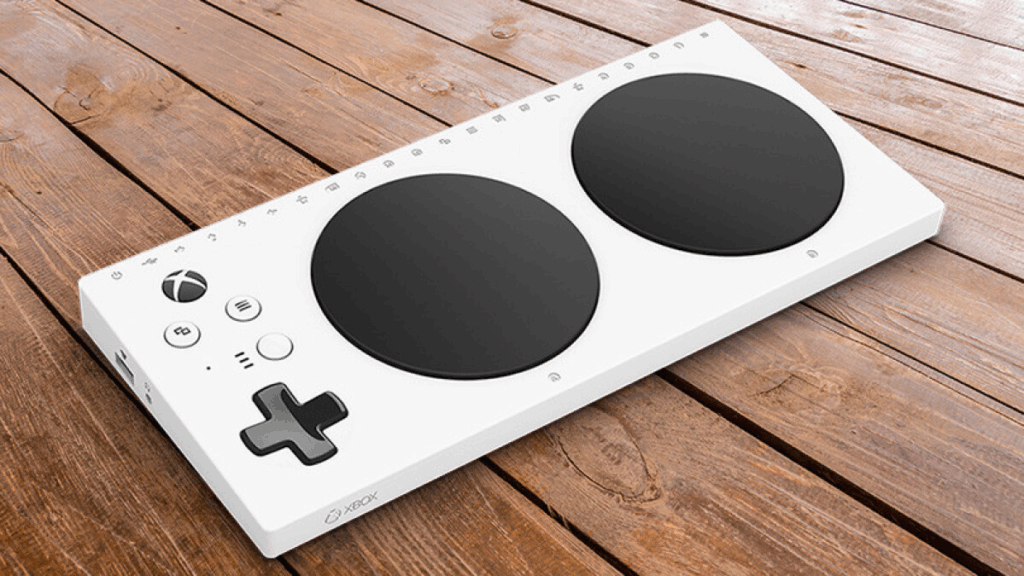
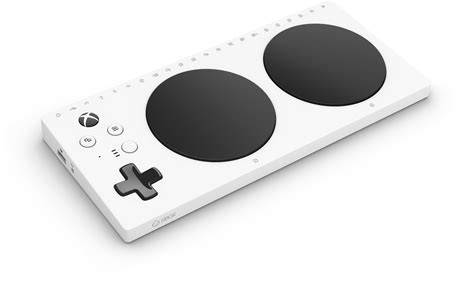
Released in 2018, this was the game-changer. It looks like a sleek, white rectangle with two massive black buttons.
- The Hub Approach: The XAC is essentially a switchboard. It has 19 ports on the back, each corresponding to a button on a standard Xbox controller (A, B, X, Y, RB, LB, etc.).
- Co-Pilot Mode: This software feature allows two controllers (an XAC and a standard controller) to act as one. This means a parent or friend can help control movement while the adaptive gamer controls the actions, or vice versa.
2. The PlayStation Access Controller
Sony’s answer to the XAC, released recently for the PS5, takes a different geometric approach. It looks like a circular “kit” rather than a flat board.
- 360-Degree Orientation: The controller can be used in any orientation (upside down, sideways) because the analog stick can be rotated and locked into place software-side.
- Button Swapping: It comes with a variety of button caps (flat, curved, overhang) that you can physically swap out to find the most comfortable shape for your hand or limb.
3. Third-Party Innovators
- Logitech G Adaptive Gaming Kit: This is a bundle of robust buttons and triggers designed specifically to plug into the Xbox or PlayStation hubs. It provides the “Lego bricks” players need to build their setups without breaking the bank.
- 8BitDo Lite SE: Designed for gamers with limited mobility who still want a handheld form factor. It lays all buttons flat on the face (no triggers on the back) and uses low-resistance buttons that require very little force to press.
Why This Matters: The Human Impact
The technical specs are impressive, but the real story is human.
For a gamer with Spinal Muscular Atrophy (SMA), an adaptive controller means they don’t have to stop gaming when their hands get tired. For a veteran who has lost a limb, it means they can rejoin their squad in Call of Duty.
These controllers provide:
- Independence: Setting up a rig that requires no assistance to use.
- Social Connection: Gaming is a massive social outlet. Accessibility keeps people connected to their friends.
- Therapeutic Value: Many occupational therapists now use adaptive gaming to help patients work on fine motor skills and cognitive processing in a way that feels like fun, not work.
The Future of Play
We are moving toward a future where “accessibility” isn’t a niche category, but a standard feature. We are seeing adaptive controllers used in esports tournaments and integrated into game design from day one.
The rise of adaptive controllers proves a simple truth: Gaming is for everyone. When we build tools that include more people, we don’t just get more players; we get a richer, more diverse, and more vibrant community.
And that is a high score worth chasing.